You used to trust your own judgment. Now you second-guess everything.
You replay conversations. Reopen decisions you've already made. Ask someone else what they think before trusting what you think.
And even after you decide, the question comes back:
What if I'm wrong?
Maybe this looks familiar.
Eventually, the hardest person to trust can become yourself.
You didn't forget how to make decisions.
Self-trust doesn't disappear all at once. It erodes gradually.
Repeated criticism, manipulation, betrayal, high-conflict situations, ignored red flags, fear of consequences, or simply spending a long time in circumstances where every decision felt consequential can teach someone to repeatedly check and recheck their own judgment.
Over time, that checking becomes automatic. The habit of second-guessing yourself becomes the default—even in situations that don't require it.
The goal isn't blind confidence. It's learning how to evaluate what you're seeing and feeling without automatically assuming your fear—or someone else's certainty—must be right.
"Just trust your gut" isn't very helpful when you don't know what you're hearing.
Sometimes fear contains useful information.
Sometimes fear is simply demanding certainty.
Sometimes past experience affects the present.
Sometimes another person's voice has become louder than your own.
Generic advice—"trust yourself," "follow your intuition," "stop overthinking"—doesn't solve the actual problem. It assumes you can already tell the difference between useful caution and fear that's simply making noise.
This isn't another pep talk about confidence. It's a practical way to start rebuilding evidence that you can rely on your own judgment.
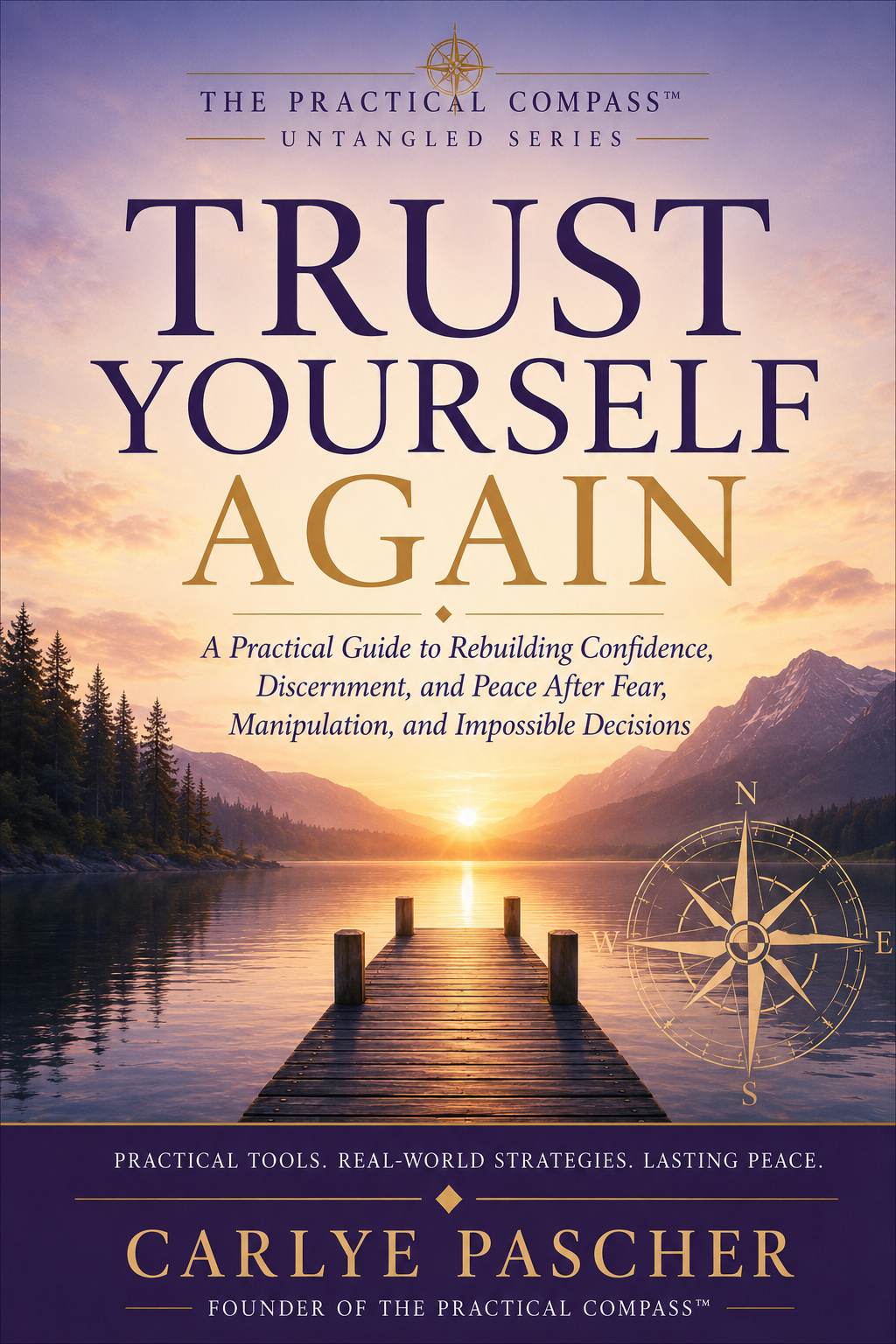
Trust Yourself Again gives you a way forward.
The guide helps you understand how self-trust gets disrupted—and then rebuild it through practical frameworks, reflection, evidence, and repeated small decisions.
The goal is not:
Never feeling doubt.
Always being right.
Becoming fearless.
Making perfect decisions.
The goal is being able to make a thoughtful decision without allowing uncertainty to automatically send you back to square one.
Inside, you'll learn how to:
This isn't just something you read. It's something you use.
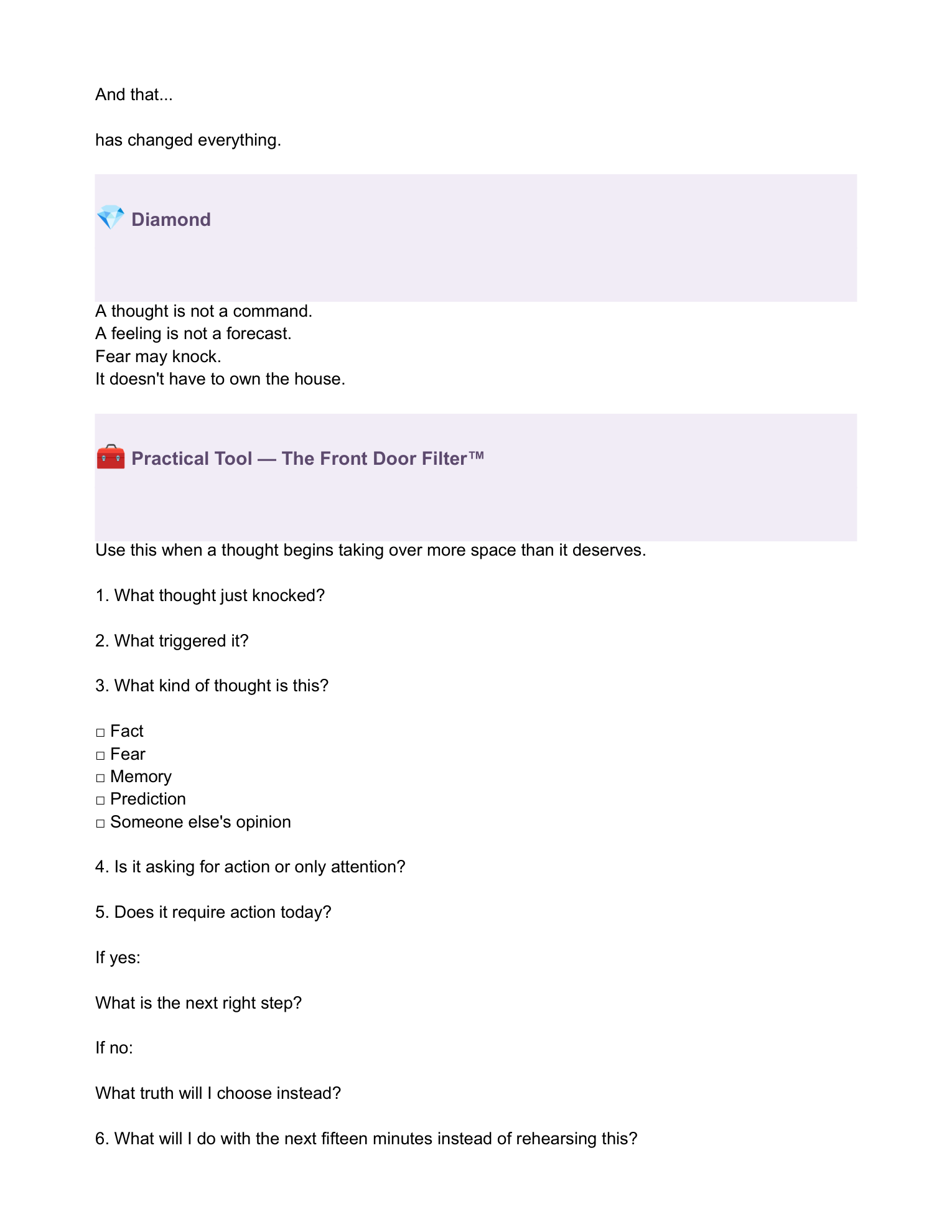
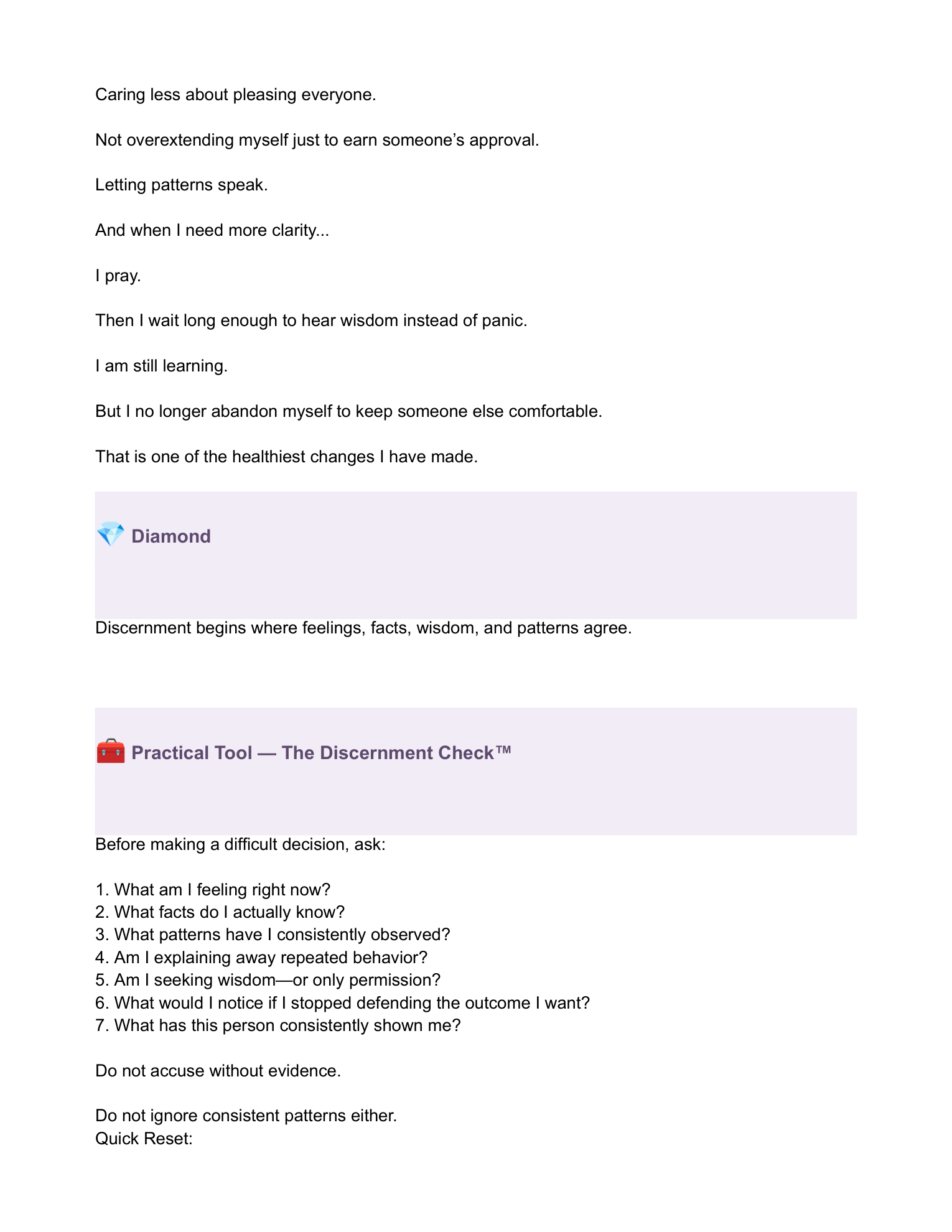
Trust Yourself Again contains eight named Practical Tools throughout the guide — each one designed to help you slow the spiral, separate fear from what you actually know, recognize patterns, and begin rebuilding trust in your own judgment.
The Front Door Filter™
Helps you identify the thought that has taken over, distinguish whether it is a fact, fear, memory, prediction, or someone else's opinion, determine whether it actually requires action, and choose what happens next.
The Discernment Check™
Helps you examine feelings, facts, repeated patterns, whether you are explaining away behavior, whether you are seeking wisdom or permission, and what someone has consistently shown you.
The Return to Yourself Inventory™
Helps you notice what survival or prolonged stress may have pushed aside and identify small, practical ways to reconnect with yourself.
These aren't generic journal prompts. They're practical tools designed to help you slow the spiral, separate fear from what you actually know, recognize patterns, and begin rebuilding trust in your own judgment.
The guide is structured to be both read and returned to. The frameworks and exercises are designed for repeated use — not just the first time doubt surfaces, but every time after that.
The goal isn't to never doubt yourself again.
You may still feel nervous.
You may still wonder whether you've chosen perfectly.
You may still have moments when an old voice tells you to reconsider everything.
Rebuilding self-trust doesn't mean eliminating uncertainty.
It means learning not to treat uncertainty as proof that you're wrong.
You can feel uncertain and still trust yourself enough to move forward.
Trust Yourself Again may be for you if...
You don't need to have experienced an abusive relationship for this guide to be relevant. Self-trust can erode for many different reasons.
Questions
Is this only for people who have experienced manipulation or unhealthy relationships?
No. Those experiences can damage self-trust, but so can betrayal, prolonged uncertainty, difficult decisions, repeated criticism, major life changes, and other experiences that cause someone to repeatedly question their own judgment. You don't need a specific history for this guide to be relevant.
Is this therapy?
No. Trust Yourself Again is an educational, practical self-guided resource and is not therapy, mental-health treatment, diagnosis, or a substitute for professional care. If you need professional support, please seek a qualified provider.
Do I need to read What Actually Matters? first?
No. Each Practical Compass guide stands on its own. They address related but different problems. What Actually Matters? helps you decide what deserves your time and attention. Trust Yourself Again helps you trust your own judgment about what you're seeing and what to do next.
What format is the guide?
A digital PDF available immediately after purchase. You can read it on your phone, tablet, or computer.
Is this something I read once?
It is designed to be both read and reused. The practical frameworks and exercises can be returned to whenever doubt or second-guessing resurfaces—not just the first time.
Two guides. Two different problems.
What Actually Matters?
“Does this deserve my time, energy, attention, or action?”
A practical framework for deciding what deserves your response, documentation, time, energy, and money—especially when everything feels urgent.
Each guide is useful on its own. Many readers find both relevant.
The next time doubt surfaces, you'll have something to reach for.
Not a pep talk. Not a reminder to believe in yourself.
Practical tools for sorting through what you're actually seeing, what you actually know, and what you can actually do next.
That's what Trust Yourself Again is built for.
Trust Yourself Again
Immediate PDF access — $37
Digital product • Immediate access after purchase