
Should I Respond to This Text? How to Decide Before You Reply
Published August 2026•7 min read
A simple framework to help you pause, get clear, and choose your next move with confidence.
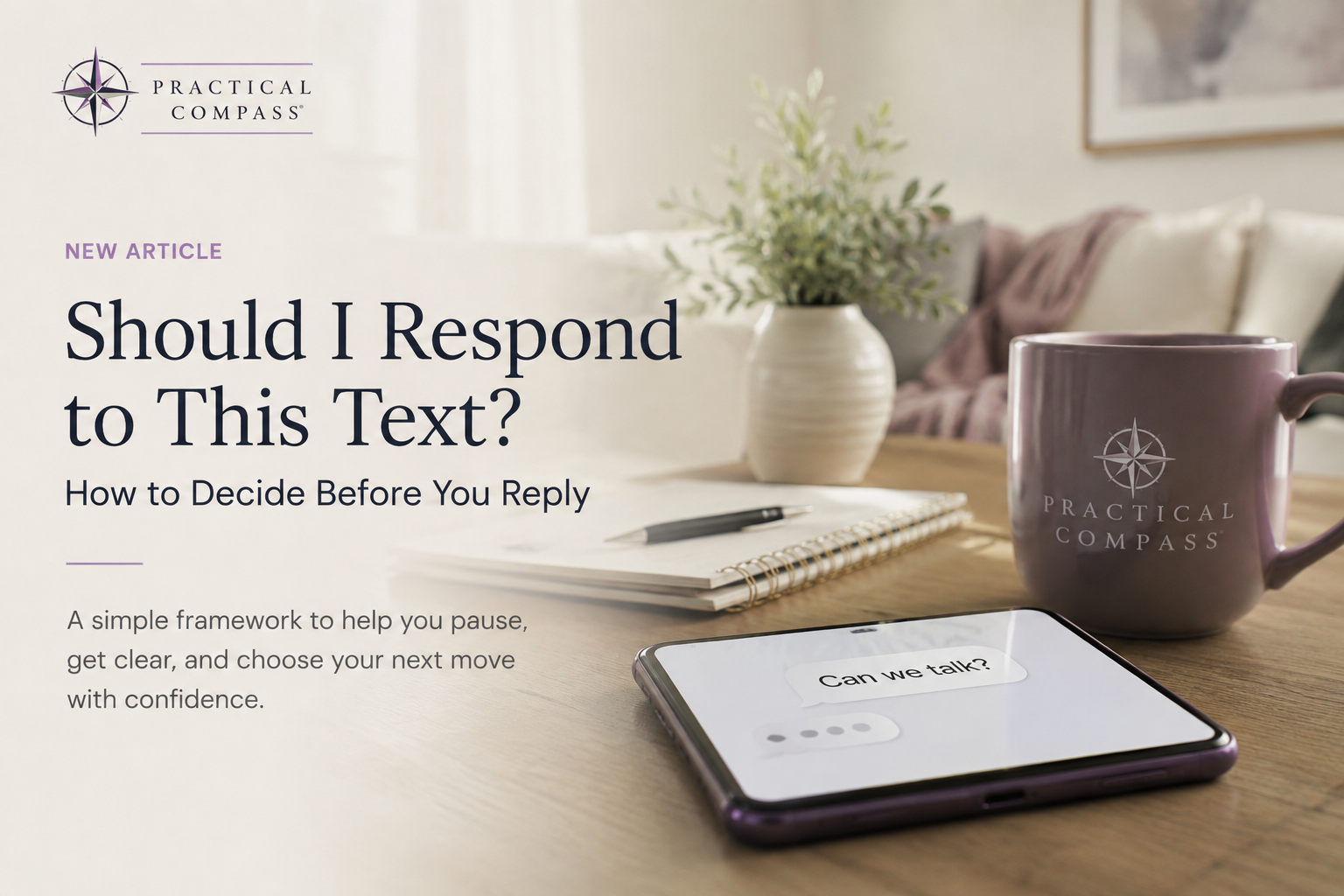
You got a text.
You read it once.
Then again.
Now you've drafted a response, deleted it, reread the original message, wondered what they really meant, and started predicting what might happen if you respond.
Or don't respond.
Maybe it's an ex.
Maybe it's a co-parent, family member, friend, coworker, or someone who knows exactly how to push your buttons.
Either way, what should have taken thirty seconds has somehow taken up the better part of your afternoon.
Before you figure out what to say, there may be a more useful question:
Does this actually require a response from you right now?
Do You Actually Need to Respond to the Text?
A message appearing on your phone creates a strange sense of urgency.
It's there.
You've seen it.
They may know you've seen it.
And suddenly it feels like a clock has started.
But receiving a message and owing someone an immediate response are two different things.
Unless you're dealing with something genuinely time-sensitive, you are usually allowed to stop before deciding what comes next.
That pause matters because the first question shouldn't always be:
What should I say?
Sometimes the better questions are:
Do I need to say anything?
Does this need to be handled today?
Is there actually a decision here, or am I reacting to how uncomfortable the message made me feel?
Those are very different problems.
Why Am I Overthinking This Text So Much?
Sometimes the actual message is only twelve words long.
The mental conversation you have afterward is approximately 47 pages.
You start analyzing punctuation.
Was that period aggressive?
Why did they phrase it that way?
Are they trying to get a reaction?
Maybe you should clarify.
Actually, maybe clarifying will make things worse.
Maybe silence looks guilty.
Maybe you should send something short.
But not too short.
And suddenly you've held six imaginary conversations with a person who isn't even in the room.
The problem is that more thinking doesn't always produce more clarity.
At some point, you're no longer gathering new information.
You're running the same information through your brain again hoping it will eventually produce certainty.
It usually doesn't.
If this pattern feels familiar, you might also find it useful to read how to stop overthinking every decision.
Before You Reply, Separate the Message From Your Reaction
There is what actually happened.
And then there is everything your brain immediately started doing with it.
Those aren't always the same thing.
The message might say:
"We need to talk about what happened yesterday."
Your brain may translate that into:
They're furious. This is going to become a huge fight. I need to explain myself before they decide I'm the problem.
Maybe.
But none of that was actually in the text.
Before responding, go back to what you know.
What did the person literally say?
What are you assuming?
What are you predicting?
What are you afraid might happen?
You don't have to pretend your concerns aren't valid.
You just don't want an assumption quietly turning itself into a fact before you've even decided what to do.
This is also where it helps to understand the difference between anxiety and intuition — because strong internal reactions don't always mean something is wrong.
Does This Message Actually Require Action?
Some messages genuinely need a response.
A schedule needs to be confirmed.
Someone needs information from you.
There's a deadline.
A child needs something.
A work issue needs to be handled.
A logistical decision has to be made.
Other messages may feel extremely important without actually requiring immediate action.
That's where people can lose hours.
The emotional intensity of a message can make it feel urgent even when the practical situation isn't.
So instead of asking:
How strongly do I feel about this?
Try asking:
What, specifically, needs to happen next?
Sometimes there's a clear answer.
Sometimes the answer is: nothing yet.
That's still an answer.
You Don't Have to Answer the Entire Relationship
This is especially important when there's history behind the message.
You aren't just responding to:
"Can we talk?"
You're responding to the last argument.
And the argument before that.
And the thing they said six months ago.
And the pattern you're afraid is starting again.
And the imaginary conversation you're already having about what happens after you respond.
That's a lot to fit into one text message.
You don't necessarily have to.
If something requires a response, respond to what actually requires a response.
You don't have to resolve the entire history of a relationship every time your phone lights up.
Stop Looking for the Perfect Text Response
Sometimes we keep thinking because we believe there is a response that will guarantee the outcome we want.
If I word this perfectly, they won't misunderstand me.
If I explain enough, they'll finally see my side.
If I wait exactly the right amount of time, I won't look reactive.
If I don't respond, maybe they'll realize what they did.
If I do respond, maybe I can prevent this from escalating.
There may not be a perfect option.
And there definitely isn't a text message capable of controlling another person's reaction.
Your job is not to engineer every possible outcome.
Your job is to decide what makes sense based on the information and responsibilities you actually have.
That's much more manageable.
Should You Respond Right Away or Wait?
Waiting isn't always avoidance.
Sometimes it's simply refusing to make a decision while you're activated.
Put the phone down.
Go do something else.
Come back when the message doesn't feel quite as enormous.
If there really is something that requires action, it will still be there.
And if twenty minutes of distance changes how urgently you feel compelled to respond, that's useful information too.
You don't have to solve everything at the exact moment it enters your life.
What to Do Before You Respond
If you're staring at a message right now, don't start by writing the response.
Start with what you actually know.
Then consider what genuinely needs your attention.
Not everything you're worried about.
Not everything this situation reminds you of.
Not every possible thing the other person might think, say, or do next.
Just what actually needs your attention.
That may lead you to respond.
It may lead you to wait.
It may show you that there's something worth documenting or handling elsewhere.
And sometimes you'll realize that the thing consuming most of your mental energy doesn't actually require anything from you at all.
That distinction can save you an enormous amount of time.
Still replaying the message?
If you've read the message twelve times and still can't figure out whether you need to act, wait, document something, or put it down, the free Time Filter™ was designed specifically for this kind of moment.
GET THE FREE TIME FILTER™Free instant download • No spam • Unsubscribe anytime
Frequently Asked Questions
Should I respond to a text right away?
Not necessarily. A text arriving on your phone can feel urgent even when the situation isn't. If the message isn't genuinely time-sensitive, giving yourself some space before responding can help you separate what actually needs action from the pressure you feel to do something immediately.
Is it okay not to respond to a text?
Sometimes. Not every message requires a response, but context matters. A logistical question, deadline, work responsibility, parenting issue, or other practical matter may require action. The important distinction is between something that actually needs your attention and something that simply creates a strong emotional reaction.
Why do I overthink text messages before responding?
Text messages leave out tone, facial expression, and context, which gives your brain plenty of room to fill in the blanks. If there's history or tension with the sender, it's even easier to start predicting motives, reactions, and outcomes that haven't actually happened.
What should I do if I can't decide whether to respond or ignore a message?
Start by separating what the message literally says from what you're assuming or predicting about it. Then identify whether anything genuinely requires action right now. If you're still stuck replaying the situation, use the free Time Filter™ to help sort through what actually deserves your attention.
Practical Compass provides educational tools and general information. It is not legal, mental health, financial, or medical advice. If a situation involves immediate safety concerns, seek appropriate professional or emergency support.